
Compare mechanical, chemical and enzymatic polyester recycling, understand polyester-spandex limitations, and ask better questions before sourcing fabric.
Textile-to-textile polyester recycling turns textile waste into raw material for new textiles. The recycled-content percentage alone does not tell you whether a fabric came from old clothing, how it was processed, or whether it has a practical next recycling route. Ask for the feedstock, process and evidence together.

What did Première Vision Paris put on the agenda?
The September 2026 edition’s official Innovation & Technology programme describes REO ECO’s BioCulus display: a journey from used textiles to recycled yarn. Première Vision says the system uses enzymes to break down polyester selectively, works at low temperatures and can process blended fabrics. It also describes the displayed production route as using no virgin material. These are claims about the featured system, not a specification for every recycled fabric. [1]
For a fabric buyer, the useful development is the visibility of the process. A finished swatch can look convincing while leaving important questions unanswered: What went into it? What was separated out? Which part became new yarn?
This guide draws on published exhibition material and technical sources. It is not a report of a SEMO factory trial or a claim that SEMO supplies BioCulus or CARBIOS materials.
Why is “recycled polyester” an incomplete description?
Recycled polyester describes an input history, not one production method. Textile Exchange’s 2025 Materials Market Report, covering 2024, puts polyester at 59% of global fibre output and reports that 98% of recycled polyester still came from plastic bottles. Those figures describe the global market in that reporting year, not the composition of an individual product. [2]
Separate three decisions in your specification: the original waste source, the recycling process and the final fabric construction. A bottle-derived polyester yarn and a textile-derived polyester yarn may both be labelled recycled. Either may then be woven with other fibres. The label cannot replace the full bill of materials.
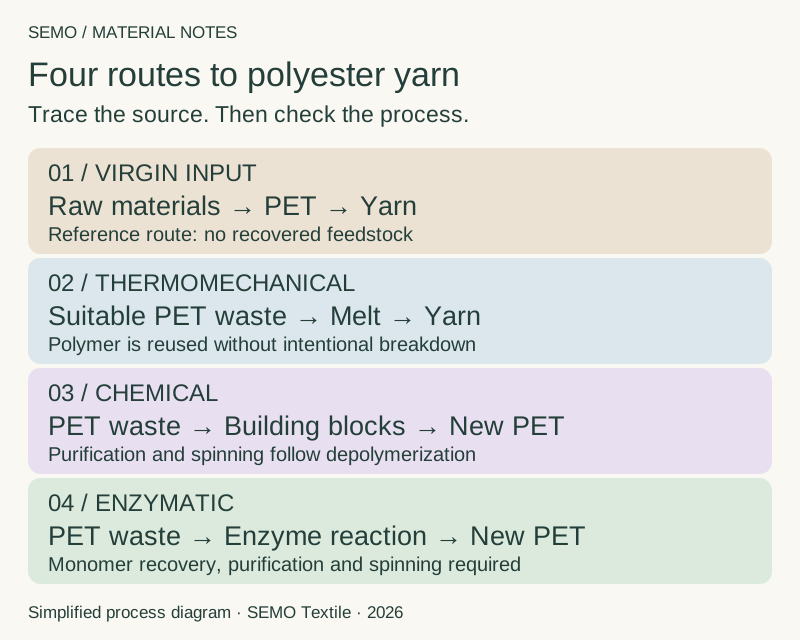
Mechanical vs chemical vs enzymatic recycling: what changes?
Mechanical recycling keeps the polymer in use
In the thermomechanical PET route, suitable waste is sorted, cleaned, reduced in size, melted, filtered and extruded for further production. It does not intentionally break PET back into its starting molecules. Textile Exchange distinguishes this melting route from mechanically opening textiles into fibres. Calling both simply “mechanical recycling” can obscure what a supplier actually does. [3]
For procurement, ask which waste stream the line accepts and what yarn specification it can repeatedly deliver. A process that works with a consistent bottle stream is not automatically qualified for a dyed, finished, multi-fibre garment.
Chemical recycling rebuilds the polymer
Depolymerization breaks PET into smaller chemical building blocks, which are separated and purified before new polymer is made. Hydrolysis, glycolysis and methanolysis are different routes, with different inputs and operating conditions. Research in Nature Communications examines PET depolymerization, purification and repolymerization as parts of a complete recovery system. Recovering molecules is an intermediate step; spinning usable new yarn still has to follow. [4]
Enzymatic recycling uses a biological catalyst
Enzymes can catalyse the breakdown of PET. That makes enzymatic recycling a form of depolymerization, rather than a route that avoids chemistry. The monomers still require recovery and purification, followed by polymer production and spinning. The enzyme’s selectivity does not mean every other fibre in a blend becomes recycled polyester. [3] [5]
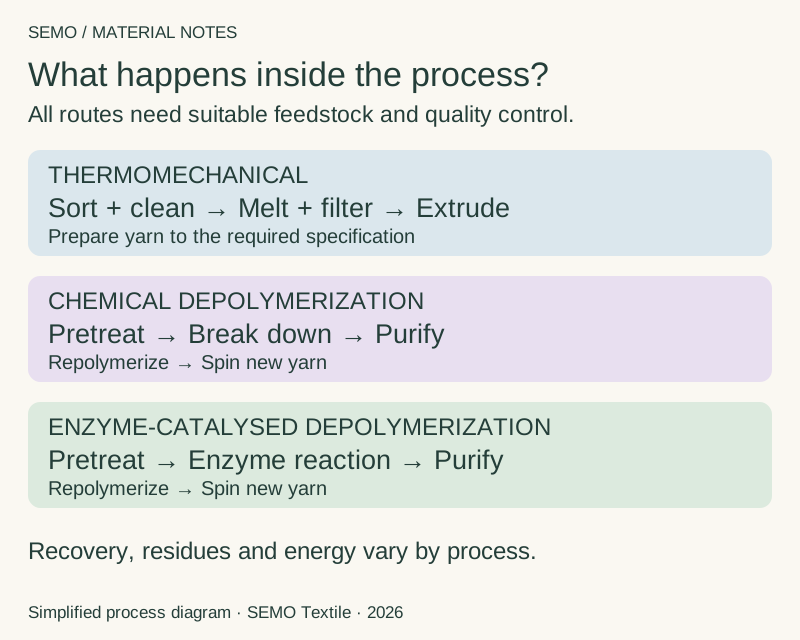
| Route | Main distinction | Ask for |
|---|---|---|
| Thermomechanical | Remelts PET without intentional depolymerization | Input purity and repeatable yarn performance |
| Chemical | Breaks down, purifies and rebuilds PET | Named process, recovery yield and operating scale |
| Enzymatic | Uses enzymes to catalyse PET breakdown | Accepted blends, pretreatment and output evidence |
Is enzymatic polyester recycling commercially ready?
There is industrial demonstration evidence, but readiness must be checked supplier by supplier. On 21 July 2026, CARBIOS announced its 100th demonstration-plant batch and reported more than 95% conversion within 24 hours on complex textile waste. It also announced an expanded textile licensing offer. These are company-reported results under its process conditions. [5]
A conversion percentage is not the percentage of an entire garment recovered as saleable new fabric. Nor does a completed demonstration batch establish your order’s price, available capacity or lead time. Before approving development, request the intended supply site, minimum quantity, delivery window and the evidence connecting the proposed yarn to that process.
Is bottle-to-fiber the same as textile-to-textile recycling?
No. Bottle-to-fiber transfers packaging material into textiles. Textile-to-textile uses textile waste to make new textiles. Textile Exchange identifies the industry’s dependence on bottle feedstock and the need to develop textile-to-textile systems. A recycled input does not, by itself, establish a collection and recovery route for the finished garment. [6]
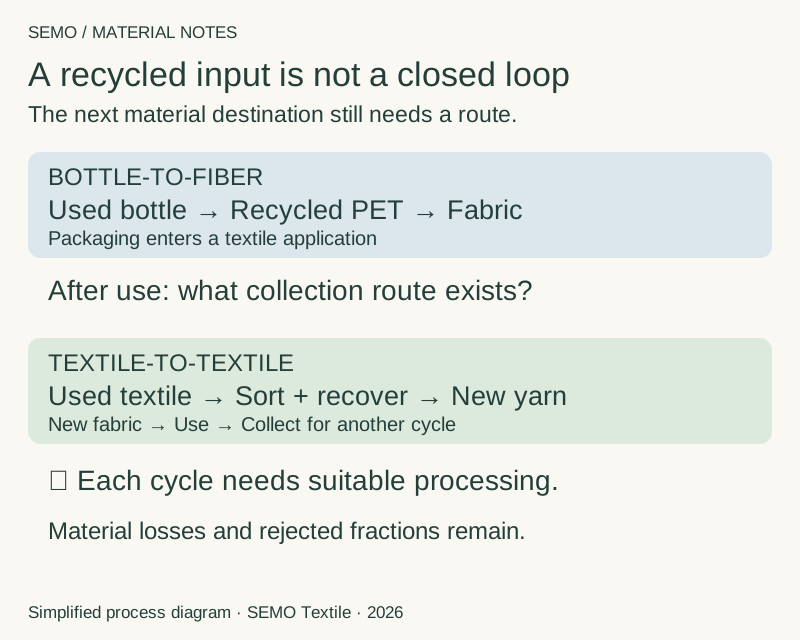
For buyers, “closed loop” should lead to a specific question: who will accept this finished construction after use? Ask whether that route is currently available in the target market, and whether the recycler accepts the complete garment or only a separated polyester fraction.
Does a newer recycling process always have a lower impact?
No single process name establishes environmental performance. Textile Exchange’s 2026 polyester LCA compares specified virgin and recycled production routes within defined study boundaries. It is a basis for examining particular systems, not a universal ranking of every recycled fabric. [7]
When a supplier provides an impact figure, request the functional unit, system boundary, energy assumptions, feedstock and assessment date. A resin-level result cannot simply be presented as a finished-garment result. Dyeing, finishing, use and end-of-life may sit outside that boundary. Comparisons should refer to equivalent outputs and make exclusions visible.
Can polyester-spandex fabric be recycled?
Some processes can recover polyester from polyester-elastane blends, but acceptance is process-specific. Elastane, also called spandex, adds another polymer to the waste stream. A 2026 laboratory study on PET/elastane depolymerization discusses reagent consumption, by-products and the difficulty of fully accounting for the elastane fraction. A successful laboratory route is not evidence that every commercial recycler accepts stretch fabric. [8]
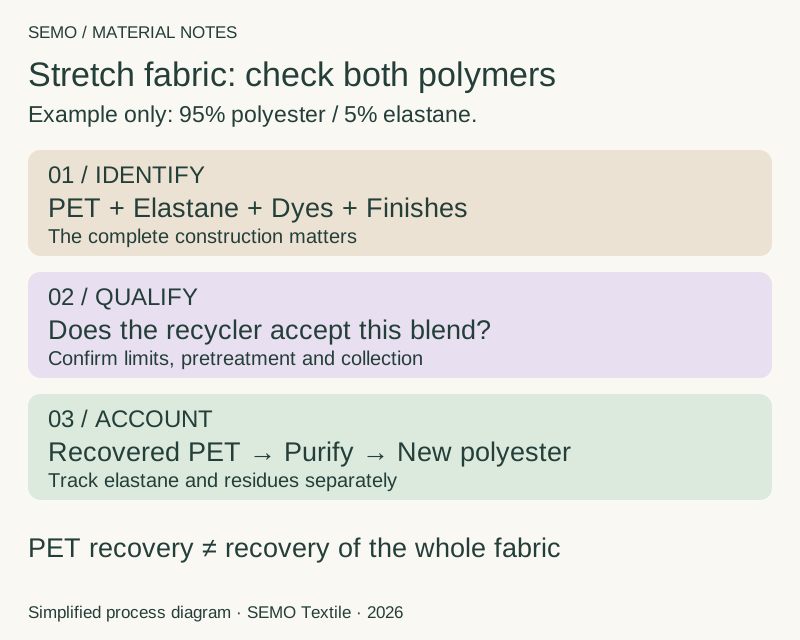
Consider a hypothetical 95% polyester / 5% elastane trouser fabric. A supplier might offer recycled polyester for the 95% portion while using conventional elastane for the remainder. The buyer still needs to establish the recycled share of the whole fabric, the evidence supporting it and the destination of both polymers after use.
For a stretch-woven development, our suggested comparison is practical: keep the garment requirement fixed, then compare the current construction with a lower-elastane or mechanical-stretch option where available. Evaluate recovery, growth after wear, drape, shrinkage and seam behaviour before deciding. A simpler composition is not an improvement if the garment fails its intended use; it also still needs a confirmed recycling route.
What should you ask before sourcing recycled polyester fabric?
Use this checklist at the quotation stage, while missing information can still change the development decision. Record the answers against the actual article and proposed production lot.
- What is the waste source? Ask for bottles or textiles, pre-consumer or post-consumer origin, and whether multiple sources are mixed. “Recycled yarn” alone is insufficient.
- Which process and facility make the yarn? Request a named recycling route and the identity of the supplier responsible for the claimed output. Distinguish a sample programme from routine supply.
- How much of the complete fabric is recycled? Clarify whether a quoted percentage applies to polyester only, a yarn or the entire fabric. Ask whether virgin polymer or other fibres are added.
- What evidence follows this order? Request applicable current certification, its scope and order-level chain-of-custody documentation. Check that the product and parties match the claim; do not treat a generic certificate as proof of every item.
- Will the material meet the garment brief? Agree on weight, usable width, handfeel, stretch and recovery, colour performance, shrinkage and bulk consistency. Ask for sample and bulk approval criteria.
- What is the next recovery route? Identify a recycler, accepted composition, collection arrangement and the fate of non-PET material. If there is no established route, record it as an unresolved limitation.
Where does this leave fabric development?
The useful shift is from asking only “how much is recycled?” to specifying source, process, performance and the next material destination. For a buyer, a complete answer is more valuable than the newest technology name.
SEMO focuses on woven fabrics for womenswear. You can compare polyester-spandex fabric constructions or explore yarn-dyed checks and stripes for a development brief. These collections are construction references; this article does not designate them as recycled or certified products.
For a sourcing discussion, send the garment application, target weight and width, required stretch, quantity and the recycled-content evidence your project needs. Availability and claims need to be confirmed for the specific proposal.
Discuss a fabric development →Sources & further reading
Prepared by SEMO Textile · Research reviewed 7 September 2026. Figures retain their original reporting periods. Exhibition and company statements are attributed to their publishers. Diagrams are original, simplified explanations.
- Première Vision Paris — Innovation & Technology, September 2026 ↗
- Textile Exchange — Materials Market Report 2025 (2024 production data) ↗
- Textile Exchange — Guide to Recycled Inputs, v1.0 (2021), sections C3–E ↗
- Nature Communications (2024) — Depolymerization mechanisms and closed-loop assessment in polyester waste recycling ↗
- CARBIOS — 100 demonstration batches and textile licensing announcement, 21 July 2026 ↗
- Textile Exchange — The Future of Synthetics (2024) ↗
- Textile Exchange — Polyester Life Cycle Assessment: Summary (2026) ↗
- Solid State Alkaline Depolymerization of Polyester Elastane Textiles in a Laboratory Kneader (2026) ↗